Buy madonna.eu ?
We are moving the project
madonna.eu .
Are you interested in purchasing the domain
madonna.eu ?
domain@kv-gmbh.de · 0541-91531010
Buy madonna.eu ?
What did Poggio steal?
Poggio Bracciolini, an Italian scholar and scribe, is known for stealing a manuscript containing the only surviving copy of Lucretius' "De rerum natura" (On the Nature of Things) from a German monastery in the 15th century. This act of theft was significant because it led to the rediscovery and subsequent dissemination of this important work of ancient Roman poetry and philosophy, which had been lost for centuries. Poggio's theft played a crucial role in preserving and transmitting the ideas of Lucretius to future generations. **
What is the name of this mobile phone song Ai di di di di di di dai? I think it's a Russian song.
The song you are referring to is "Ai, Ai, Ai" by the Russian artist Polina Gagarina. It is a popular Russian pop song that gained international recognition. The catchy melody and upbeat rhythm have made it a favorite for mobile phone ringtones and music downloads. If you enjoy this song, you may also like other hits by Polina Gagarina. **
Similar search terms for Il-Vigneto-di-Poggio
Top-Angebote
Products related to Il-Vigneto-di-Poggio:
-
Il Guardiano Poggio Mandorlo 2020Poggio Mandorlo presents ‘Il Guardiano’, a Supertuscan made exclusively in steel, in order to preserve the freshness and all the varietal components of the grapes at the base of the blend: Sangiovese and Merlot. We are in Toscana, at the foot of Monte Amiata, in the heart of Alta Maremma. Here, Poggio Mandorlo cultivates 12 hectares of vineyards planted with Sangiovese, Merlot, and Cabernet Franc, varieties that benefit from volcanic soils and a mild, breezy climate. The first vintage produced of this label was 2009. ‘Il Guardiano’ Poggio Mandorlo comes from a blend of Sangiovese (85%) and Merlot (15%), planted between 2001 and 2002 on soils made up of sandstone marls and limestone, at about 400 meters above sea level. Following manual harvesting and careful selection, the grapes are transferred to the winery for alcoholic fermentation in steel tanks at controlled temperature, with 16-18 days of contact between the must and the skins. The subsequent maturation period always takes place in steel for 18 months, followed by 4-6 months of refinement in bottle before its market release. To the eye, Poggio Mandorlo ‘Il Guardiano’ presents itself with a dark ruby red color. Intense and complex are the fruity and floral perceptions, accompanied by aromas of underbrush and aromatic herbs, while the tasting is soft and balanced, supported by lively freshness and moderate tannic structure. Fragrant returns of great taste-olfactory correspondence. A bottle capable of highlighting the most refreshing and pure character of this blend, to be paired with various preparations based on local meats, such as lamb stew or pappardelle with hare ragù.14,00 £*Shipping: 48,00 £Secure redirect to the provider
-
Brunello di Montalcino 'Madonna delle Grazie' Magnum Il Marroneto 2013The Brunello di Montalcino Selezione "Madonna delle Grazie" Il Marroneto in Magnum version is a collector's bottle that great fans of the denomination and the most discerning connoisseurs will certainly not miss. It is a prestigious label of one of the most highly rated crus in the Ilcinese territory, which, thanks to its large size, is able to evolve slowly over time and offer a complexity and depth of expression that is difficult to compare. The long ageing, in fact, enriches the Sangiovese with refined notes of tertiary evolution, giving an aromatic palette of great charm. "Madonna delle Grazie", Brunello di Montalcino Selezione, proposed in a Magnum version, confirms the extraordinary savoir-faire of the Tuscan winery Il Marroneto and the absolute value of a cru capable of always giving excellent wines. The estate is located on the northern slope of the hill and the Madonna delle Grazie parcel is characterised by the presence of old vines that are about 50 years old and are cultivated on very suitable soils, with an abundant presence of sand. The agronomic management is careful and respectful of the environment, with grassed inter-row planting and manual till harvesting, which takes place when the grapes are fully ripe. Fermentation takes place at a controlled temperature in French oak vats and the wine then matures for about 40 months in 25 hectolitre oak casks, before completing its long ageing period with 10 months in the bottle. The Brunello di Montalcino Selezione "Madonna delle Grazie" Il Marroneto wine in Magnum version allows one to fully appreciate a great red wine of our oenological heritage, known throughout the world. A perfect bottle to enjoy in the company of enthusiasts during a special dinner or to keep in the cellar for a long time without fear. A luminous garnet colour, it reveals complex and refined aromas on the nose, ranging from notes of officinal herbs and balsamic herbs to floral nuances of violets, hints of undergrowth, morello cherry and redcurrant, spicy memories and liquorice root. Well-structured, it has a dense but evolved tannic texture, which integrates perfectly with an elegant and deep palette of aromas, accompanying a fresh and very persistent finish1347,00 £*Shipping: 48,00 £Secure redirect to the provider
-
Lamole di Lamole Chianti Classico Gran Selezione 'Vigneto di Campolungo' Lamole 2021Il Chianti Classico Gran Selezione “Vigneto di Campolungo” di Lamole di Lamole è un vino della zona del Chianti Classico, conosciuta nel mondo per la sua naturale vocazione alla produzione di rossi ineguagliabili. Il comune di Greve ospita questa cantina, all’interno di un borgo medievale meraviglioso: casali, fontanili e verdi colline fanno da contorno alla produzione vitivinicola. La tenuta possiede circa 288 ettari di terreno, suddivisi in parte vitata e boschi che contribuiscono a creare un’ecosistema florido ed equilibrato che giova anche ai grappoli. L’attività vitivinicola inizia nel secondo dopoguerra, anche se la storica cantina di produzione e affinamento risale al 1300, parte del Castello di Lamole. Dal 2005 l’attività è stata interessata da un processo di riconversione sostenibile, grazie alla scelta di coltivare in maniera interamente biologica i vigneti. Le uve del Chianti Classico Gran Selezione “Vigneto di Campolungo” di Lamole di Lamole vengono coltivate a un’altitudine tra 420 e 570 metri sul livello mare; il suolo è pervaso dall’argilla con particolare presenza di pietra arenaria e appenninica e piccola percentuale di sabbia, ideale perché il Sangiovese possa sprigionare al massimo le sue caratteristiche intrinseche. I vigneti sono disposti all’interno di muretti a secco, importanti per la vigna perché riflettono la luce del giorno, stimolando la fotosintesi clorofilliana. La vendemmia si svolge tra la fine di settembre e ottobre e le uve vengono raccolte manualmente dopo un’accurata cernita dei grappoli migliori. Dopo la diraspatura e la pressatura, il mosto fermenta in botte con successiva macerazione sulle bucce per 2 settimane. Affina per la quasi totalità 30 mesi in botti di medie dimensioni, mentre una piccola parte in barrique, poi integrata al momento dell’imbottigliamento. Alla vista il Chianti Classico Gran Selezione “Vigneto di Campolungo” di Lamole di Lamole è un rosso rubino brillante con riflessi intensi. Il bouquet di profumi sprigionati ricordano i frutti di bosco a bacca rossa e nera, frutta a polpa rossa matura e sul finale sentori speziati e balsamici; in bocca è beverino, avvolgente ed elegante con tannini fitti, ma ben integrati nella struttura generale. Si abbina perfettamente a piatti a base di primi piatti conditi con sughi elaborati, zuppe ricche con sapori decisi e tagli di carne rossa della tradizione cucinati alla griglia e in umido; interessante anche con formaggi di latte vaccino di media e lunga stagionatura. Perfetto per accompagnare festeggiamenti di ricorrenze importanti o anniversari in famiglia, condividendo un prodotto unico nel suo genere.40,00 £*Shipping: 48,00 £Secure redirect to the provider
-
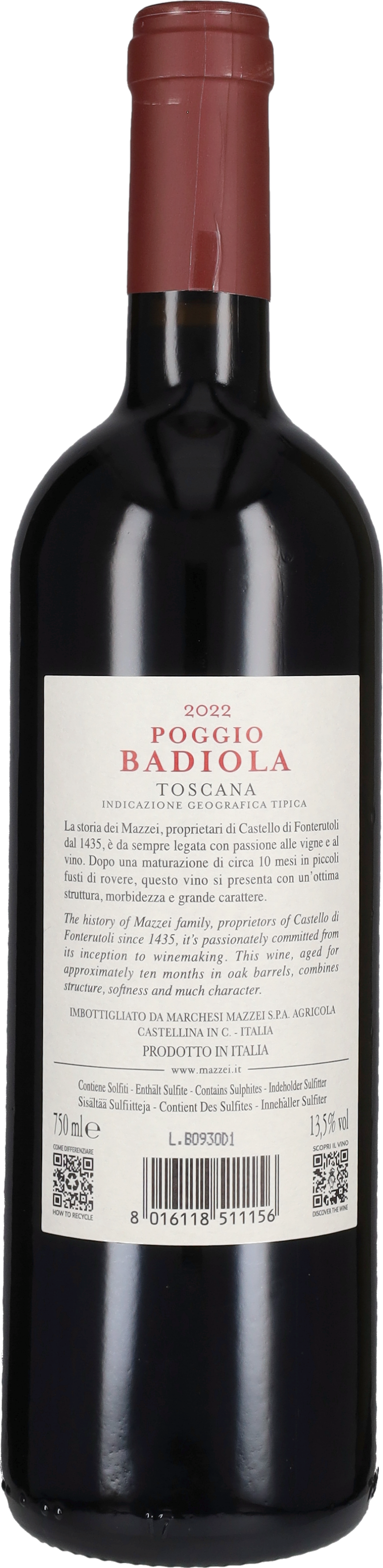
Poggio Badiola Castello di Fonterutoli - Mazzei 2022The Rosso 'Poggio Badiola' from the Tuscan winery Castello di Fonterutoli - Mazzei is a label capable of enhancing the more accessible and lively face of Supertuscans. Specifically, this bottle, marketed for the first time with the 1994 vintage, is the result of a combination of Sangiovese and Merlot, varieties from high altitude vineyards located in the heart of the Chianti Classico production area, around a Romanesque parish church dating back to the 10th century.The 'Poggio Badiola' Castello di Fonterutoli - Mazzei Rosso consists of a blend of Sangiovese (70%) and Merlot (30%) grapes cultivated in the Le Ripe vineyard, at an altitude between 450 and 510 metres above sea level on soils rich in skeleton deriving from the disintegration of alberese and galestro rocks. At the beginning of September, the grapes are harvested by hand and then placed in stainless steel tanks for temperature-controlled alcoholic fermentation accompanied by 12-15 days of maceration on the skins. The subsequent ageing period takes place in 225-litre American oak barrels and lasts for 10 months before final bottling.On visual examination, the Rosso 'Poggio Badiola' of Castello di Fonterutoli - Mazzei expresses an intense ruby red hue. Fruity sensations of currant and raspberry describe the olfactory texture together with hints of red citrus, violet, aromatic herbs and dark spices. The sip succeeds in combining structure and smoothness, with elegant tannins anticipating the fragrant and juicy finish, with good persistence. The producer himself suggests pairing 'Poggio Badiola' with platters of cured meats, tasty earthy first courses and roast meats, but also with pizza and large grilled fish, for a surprising combination.12,00 £*Shipping: 48,00 £Secure redirect to the provider


-
What is the interpretation of the Madonna with Child Madonna di Ognissanti by Giotto?
The Madonna with Child Madonna di Ognissanti by Giotto is a significant piece in art history as it marks a departure from the traditional Byzantine style towards a more naturalistic representation of the figures. The painting depicts the Virgin Mary holding the infant Jesus, surrounded by angels and saints. The intimate connection between Mary and Jesus is emphasized, symbolizing the bond between mother and child, as well as the divine nature of Christ. Giotto's use of light and shadow, as well as the emotional expressions on the faces of the figures, adds depth and realism to the scene, making it a powerful representation of the Madonna and Child theme. **
-
When do you use il faut and il ne faut pas?
"Il faut" is used to express what is necessary or required, while "il ne faut pas" is used to express what is not allowed or should be avoided. For example, you would use "il faut" to say "il faut étudier pour réussir" (it is necessary to study to succeed), and "il ne faut pas" to say "il ne faut pas fumer dans ce lieu" (smoking is not allowed in this place). These expressions are used to give advice, make recommendations, or set rules. **
-
Why is it souhaite-t-il and not souhaite-s-il?
In French, the pronoun "il" (he) is combined with the verb "souhaiter" (to wish) to form the phrase "souhaite-t-il" because of the rule of verb inversion in interrogative sentences. When forming a question in French, the subject pronoun and the verb are inverted, so "souhaite-t-il" follows this rule. The "t" is added to create a liaison between the verb and the pronoun, making the pronunciation smoother. **
-
What is the difference between il faut que and il faut?
"Il faut" is used to express a general necessity or obligation, while "il faut que" is used to introduce a specific action or event that is necessary or required. For example, "il faut manger" means "it is necessary to eat" in a general sense, while "il faut que tu manges" means "you need to eat" in a specific sense. "Il faut" is used to make a general statement about what is necessary, while "il faut que" is used to specify what needs to be done. **
What does 'Rucke di guck, Rucke di guck, Blut ist im Schuh' mean?
"Rucke di guck, Rucke di guck, Blut ist im Schuh" is a German nursery rhyme that translates to "Rock-a-bye baby, blood is in the shoe" in English. The rhyme is a traditional lullaby that tells the story of a baby being rocked to sleep while blood is found in their shoe, which is a metaphor for the baby being cared for and protected. The rhyme is meant to soothe and comfort children as they drift off to sleep. **
What comes after il faudrait in French?
In French, "il faudrait" is followed by the infinitive form of a verb. This construction is used to express a suggestion or a polite request. For example, "il faudrait partir tôt" means "it would be necessary to leave early." **
Top-Angebote
Products related to Il-Vigneto-di-Poggio:
-
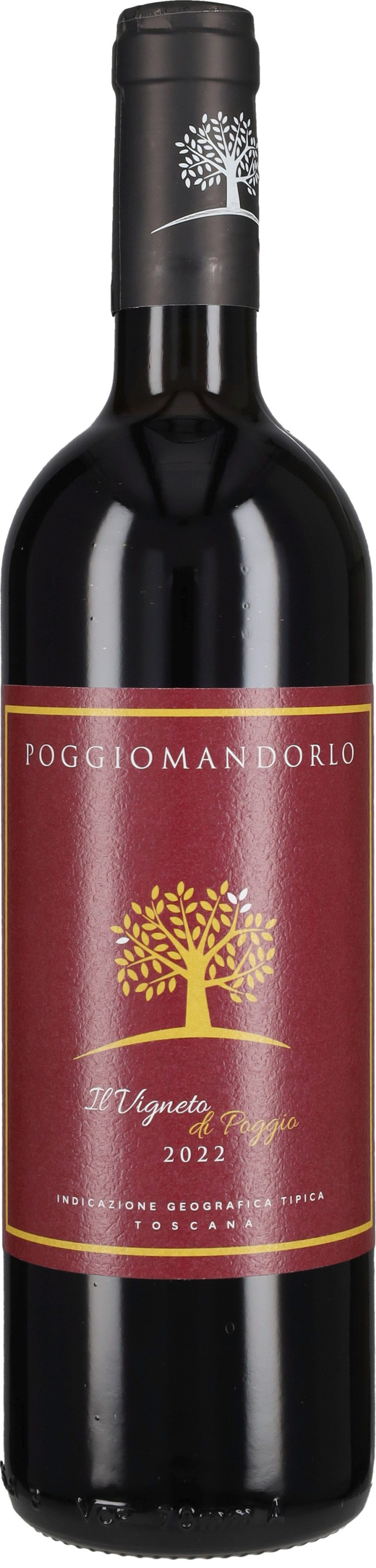
'Il Vigneto di Poggio' Poggio Mandorlo 2022“The Vineyard of Poggio” by Poggio Mandorlo is a proud expression of the rich wine landscape of Maremma. It tells the story of four friends: Roberto, Felice, Giuseppe, and Fabio, who for about twenty years have decided to experiment with the potential of a territory. Supported by the oenologist Roberto Cipresso first and then Filippo Paoletti, noted figures from the Montalcino area, they have managed to navigate the virtues of the Seggiano soils to obtain unique and never banal labels. Located at the crossroads between Val Norcia and the first hills of the Grosseto Maremma, at the foot of the Amiata volcano, the winery decides to cultivate not only Sangiovese but also rare and unique clones of Merlot and Cabernet Franc, which they import directly from Saint-Émilion in the Bordeaux region. The latest offspring of Poggio Mandorlo is precisely “the Vineyard of Poggio”, capable of expressing the versatility of the sandstone and limestone marls on which the Merlot, of which this interesting label is entirely composed, takes root. The vines were planted in 2001 and the harvest is carried out exclusively with manual selection. Fermentation takes place in stainless steel tanks at controlled temperature, during which delicate pump-overs are performed. The maceration period varies from 8 to 12 days and is meticulously monitored through chemical and sensory analysis. The 12 months of aging also take place in steel, giving us a bottle that perfectly expresses the great varietal rigor even through an international grape variety. Poggio Mandorlo with its “Vigneto di Poggio” of pure Merlot envelops us with its shining ruby veil to gift us with scents of wilted rose and wild fruit, pleasant notes of plum, underbrush, cherry, and a finish of black pepper and cinnamon. On the palate, it presents warm aromas for a full body in which the fragrance of red fruit is found, with a pleasant fresh shoulder softened by a good sapidity, the tannin is tasty and almost caressing. Poggio Mandorlo expresses all its commitment to the passion for the land and the love for good wine, reflecting in the personality of this pleasing label.12,00 £*Shipping: 48,00 £Secure redirect to the provider
-
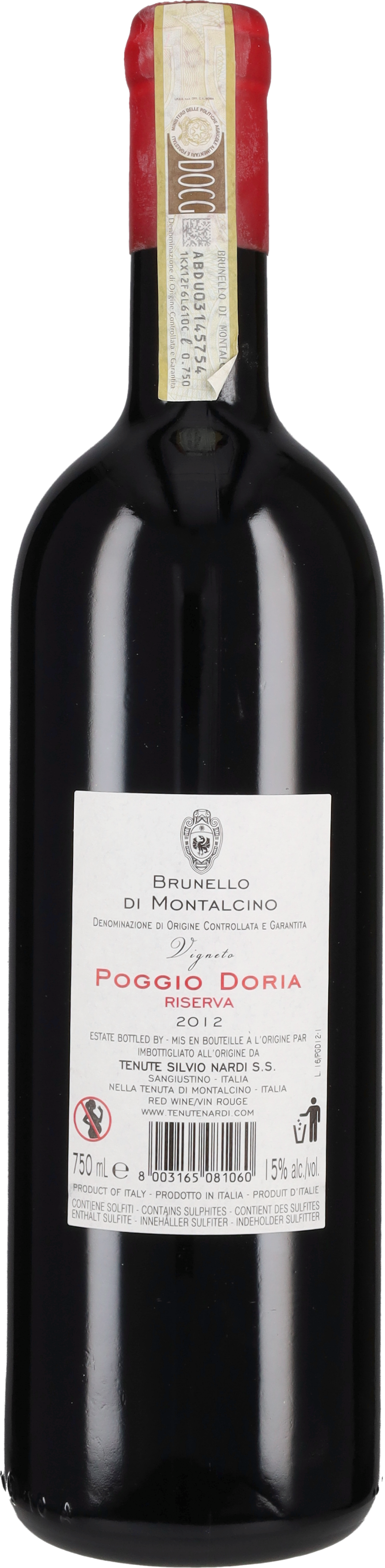
Brunello di Montalcino 'Vigneto Poggio Doria' Tenute Silvio Nardi 2012The Brunello di Montalcino Tenute Silvio Nardi ‘Vigneto Poggio Doria’ is a prestigious label capable of reflecting the elegance of Montalcino wines. The grapes destined for the Brunello ‘Vigneto Poggio Doria’ come from the Oria parcel, located on the north-western slope of Montalcino and part of the Tenuta di Casale del Bosco, the first purchased by the Nardi family. This estate dates back to the 17th century, although even in much earlier times the Etruscans practiced viticulture in the area. The ‘Vigneto Poggio Doria’ Tenute Silvio Nardi Brunello di Montalcino is a 100% Sangiovese from vines grown at an altitude of about 260 meters above sea level, on soils rich in limestone, sands, and clays, also characterized by an abundance of skeleton. After the manual harvest of the bunches, usually carried out during the second week of October, the grapes are crushed in stainless steel tanks, where alcoholic fermentation takes place at controlled temperature with 26 days of contact between the must and the skins. Once the fermentation process is completed,fermentative, the liquid is transferred into French oak tonneau from Allier, of first and second passage, for the initial aging phase of 18 months. This is followed by 12 months of maturation in large Slavonian oak barrels before bottling and further refinement in glass for as long as 36 months, aimed at bringing to market a Brunello that is already harmonious and enjoyable. The Brunello di Montalcino ‘Vigneto Poggio Doria’ by Tenute Silvio Nardi is ruby red in color with a garnet rim. The nose opens with notes of wild berries and violet, followed by mineral hints of graphite and spicy notes of nutmeg, clove, and vanilla. On the palate, it is rich, full, and harmonious, broad and enveloping, with velvety tannins that lead to a persistent and well-balanced finish.105,00 £*Shipping: 48,00 £Secure redirect to the provider
-
Il Guardiano Poggio Mandorlo 2020Poggio Mandorlo presents ‘Il Guardiano’, a Supertuscan made exclusively in steel, in order to preserve the freshness and all the varietal components of the grapes at the base of the blend: Sangiovese and Merlot. We are in Toscana, at the foot of Monte Amiata, in the heart of Alta Maremma. Here, Poggio Mandorlo cultivates 12 hectares of vineyards planted with Sangiovese, Merlot, and Cabernet Franc, varieties that benefit from volcanic soils and a mild, breezy climate. The first vintage produced of this label was 2009. ‘Il Guardiano’ Poggio Mandorlo comes from a blend of Sangiovese (85%) and Merlot (15%), planted between 2001 and 2002 on soils made up of sandstone marls and limestone, at about 400 meters above sea level. Following manual harvesting and careful selection, the grapes are transferred to the winery for alcoholic fermentation in steel tanks at controlled temperature, with 16-18 days of contact between the must and the skins. The subsequent maturation period always takes place in steel for 18 months, followed by 4-6 months of refinement in bottle before its market release. To the eye, Poggio Mandorlo ‘Il Guardiano’ presents itself with a dark ruby red color. Intense and complex are the fruity and floral perceptions, accompanied by aromas of underbrush and aromatic herbs, while the tasting is soft and balanced, supported by lively freshness and moderate tannic structure. Fragrant returns of great taste-olfactory correspondence. A bottle capable of highlighting the most refreshing and pure character of this blend, to be paired with various preparations based on local meats, such as lamb stew or pappardelle with hare ragù.14,00 £*Shipping: 48,00 £Secure redirect to the provider
-
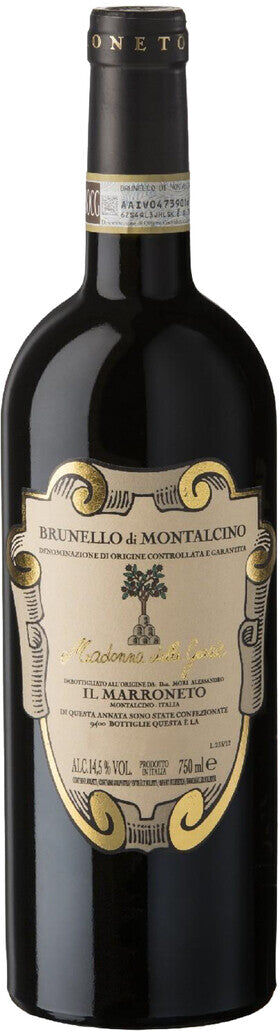
Brunello di Montalcino 'Madonna delle Grazie' Magnum Il Marroneto 2013The Brunello di Montalcino Selezione "Madonna delle Grazie" Il Marroneto in Magnum version is a collector's bottle that great fans of the denomination and the most discerning connoisseurs will certainly not miss. It is a prestigious label of one of the most highly rated crus in the Ilcinese territory, which, thanks to its large size, is able to evolve slowly over time and offer a complexity and depth of expression that is difficult to compare. The long ageing, in fact, enriches the Sangiovese with refined notes of tertiary evolution, giving an aromatic palette of great charm. "Madonna delle Grazie", Brunello di Montalcino Selezione, proposed in a Magnum version, confirms the extraordinary savoir-faire of the Tuscan winery Il Marroneto and the absolute value of a cru capable of always giving excellent wines. The estate is located on the northern slope of the hill and the Madonna delle Grazie parcel is characterised by the presence of old vines that are about 50 years old and are cultivated on very suitable soils, with an abundant presence of sand. The agronomic management is careful and respectful of the environment, with grassed inter-row planting and manual till harvesting, which takes place when the grapes are fully ripe. Fermentation takes place at a controlled temperature in French oak vats and the wine then matures for about 40 months in 25 hectolitre oak casks, before completing its long ageing period with 10 months in the bottle. The Brunello di Montalcino Selezione "Madonna delle Grazie" Il Marroneto wine in Magnum version allows one to fully appreciate a great red wine of our oenological heritage, known throughout the world. A perfect bottle to enjoy in the company of enthusiasts during a special dinner or to keep in the cellar for a long time without fear. A luminous garnet colour, it reveals complex and refined aromas on the nose, ranging from notes of officinal herbs and balsamic herbs to floral nuances of violets, hints of undergrowth, morello cherry and redcurrant, spicy memories and liquorice root. Well-structured, it has a dense but evolved tannic texture, which integrates perfectly with an elegant and deep palette of aromas, accompanying a fresh and very persistent finish1347,00 £*Shipping: 48,00 £Secure redirect to the provider
-
What did Poggio steal?
Poggio Bracciolini, an Italian scholar and scribe, is known for stealing a manuscript containing the only surviving copy of Lucretius' "De rerum natura" (On the Nature of Things) from a German monastery in the 15th century. This act of theft was significant because it led to the rediscovery and subsequent dissemination of this important work of ancient Roman poetry and philosophy, which had been lost for centuries. Poggio's theft played a crucial role in preserving and transmitting the ideas of Lucretius to future generations. **
-
What is the name of this mobile phone song Ai di di di di di di dai? I think it's a Russian song.
The song you are referring to is "Ai, Ai, Ai" by the Russian artist Polina Gagarina. It is a popular Russian pop song that gained international recognition. The catchy melody and upbeat rhythm have made it a favorite for mobile phone ringtones and music downloads. If you enjoy this song, you may also like other hits by Polina Gagarina. **
-
What is the interpretation of the Madonna with Child Madonna di Ognissanti by Giotto?
The Madonna with Child Madonna di Ognissanti by Giotto is a significant piece in art history as it marks a departure from the traditional Byzantine style towards a more naturalistic representation of the figures. The painting depicts the Virgin Mary holding the infant Jesus, surrounded by angels and saints. The intimate connection between Mary and Jesus is emphasized, symbolizing the bond between mother and child, as well as the divine nature of Christ. Giotto's use of light and shadow, as well as the emotional expressions on the faces of the figures, adds depth and realism to the scene, making it a powerful representation of the Madonna and Child theme. **
-
When do you use il faut and il ne faut pas?
"Il faut" is used to express what is necessary or required, while "il ne faut pas" is used to express what is not allowed or should be avoided. For example, you would use "il faut" to say "il faut étudier pour réussir" (it is necessary to study to succeed), and "il ne faut pas" to say "il ne faut pas fumer dans ce lieu" (smoking is not allowed in this place). These expressions are used to give advice, make recommendations, or set rules. **
Similar search terms for Il-Vigneto-di-Poggio
-
Lamole di Lamole Chianti Classico Gran Selezione 'Vigneto di Campolungo' Lamole 2021Il Chianti Classico Gran Selezione “Vigneto di Campolungo” di Lamole di Lamole è un vino della zona del Chianti Classico, conosciuta nel mondo per la sua naturale vocazione alla produzione di rossi ineguagliabili. Il comune di Greve ospita questa cantina, all’interno di un borgo medievale meraviglioso: casali, fontanili e verdi colline fanno da contorno alla produzione vitivinicola. La tenuta possiede circa 288 ettari di terreno, suddivisi in parte vitata e boschi che contribuiscono a creare un’ecosistema florido ed equilibrato che giova anche ai grappoli. L’attività vitivinicola inizia nel secondo dopoguerra, anche se la storica cantina di produzione e affinamento risale al 1300, parte del Castello di Lamole. Dal 2005 l’attività è stata interessata da un processo di riconversione sostenibile, grazie alla scelta di coltivare in maniera interamente biologica i vigneti. Le uve del Chianti Classico Gran Selezione “Vigneto di Campolungo” di Lamole di Lamole vengono coltivate a un’altitudine tra 420 e 570 metri sul livello mare; il suolo è pervaso dall’argilla con particolare presenza di pietra arenaria e appenninica e piccola percentuale di sabbia, ideale perché il Sangiovese possa sprigionare al massimo le sue caratteristiche intrinseche. I vigneti sono disposti all’interno di muretti a secco, importanti per la vigna perché riflettono la luce del giorno, stimolando la fotosintesi clorofilliana. La vendemmia si svolge tra la fine di settembre e ottobre e le uve vengono raccolte manualmente dopo un’accurata cernita dei grappoli migliori. Dopo la diraspatura e la pressatura, il mosto fermenta in botte con successiva macerazione sulle bucce per 2 settimane. Affina per la quasi totalità 30 mesi in botti di medie dimensioni, mentre una piccola parte in barrique, poi integrata al momento dell’imbottigliamento. Alla vista il Chianti Classico Gran Selezione “Vigneto di Campolungo” di Lamole di Lamole è un rosso rubino brillante con riflessi intensi. Il bouquet di profumi sprigionati ricordano i frutti di bosco a bacca rossa e nera, frutta a polpa rossa matura e sul finale sentori speziati e balsamici; in bocca è beverino, avvolgente ed elegante con tannini fitti, ma ben integrati nella struttura generale. Si abbina perfettamente a piatti a base di primi piatti conditi con sughi elaborati, zuppe ricche con sapori decisi e tagli di carne rossa della tradizione cucinati alla griglia e in umido; interessante anche con formaggi di latte vaccino di media e lunga stagionatura. Perfetto per accompagnare festeggiamenti di ricorrenze importanti o anniversari in famiglia, condividendo un prodotto unico nel suo genere.40,00 £*Shipping: 48,00 £Secure redirect to the provider
-
Poggio Badiola Castello di Fonterutoli - Mazzei 2022The Rosso 'Poggio Badiola' from the Tuscan winery Castello di Fonterutoli - Mazzei is a label capable of enhancing the more accessible and lively face of Supertuscans. Specifically, this bottle, marketed for the first time with the 1994 vintage, is the result of a combination of Sangiovese and Merlot, varieties from high altitude vineyards located in the heart of the Chianti Classico production area, around a Romanesque parish church dating back to the 10th century.The 'Poggio Badiola' Castello di Fonterutoli - Mazzei Rosso consists of a blend of Sangiovese (70%) and Merlot (30%) grapes cultivated in the Le Ripe vineyard, at an altitude between 450 and 510 metres above sea level on soils rich in skeleton deriving from the disintegration of alberese and galestro rocks. At the beginning of September, the grapes are harvested by hand and then placed in stainless steel tanks for temperature-controlled alcoholic fermentation accompanied by 12-15 days of maceration on the skins. The subsequent ageing period takes place in 225-litre American oak barrels and lasts for 10 months before final bottling.On visual examination, the Rosso 'Poggio Badiola' of Castello di Fonterutoli - Mazzei expresses an intense ruby red hue. Fruity sensations of currant and raspberry describe the olfactory texture together with hints of red citrus, violet, aromatic herbs and dark spices. The sip succeeds in combining structure and smoothness, with elegant tannins anticipating the fragrant and juicy finish, with good persistence. The producer himself suggests pairing 'Poggio Badiola' with platters of cured meats, tasty earthy first courses and roast meats, but also with pizza and large grilled fish, for a surprising combination.12,00 £*Shipping: 48,00 £Secure redirect to the provider
-
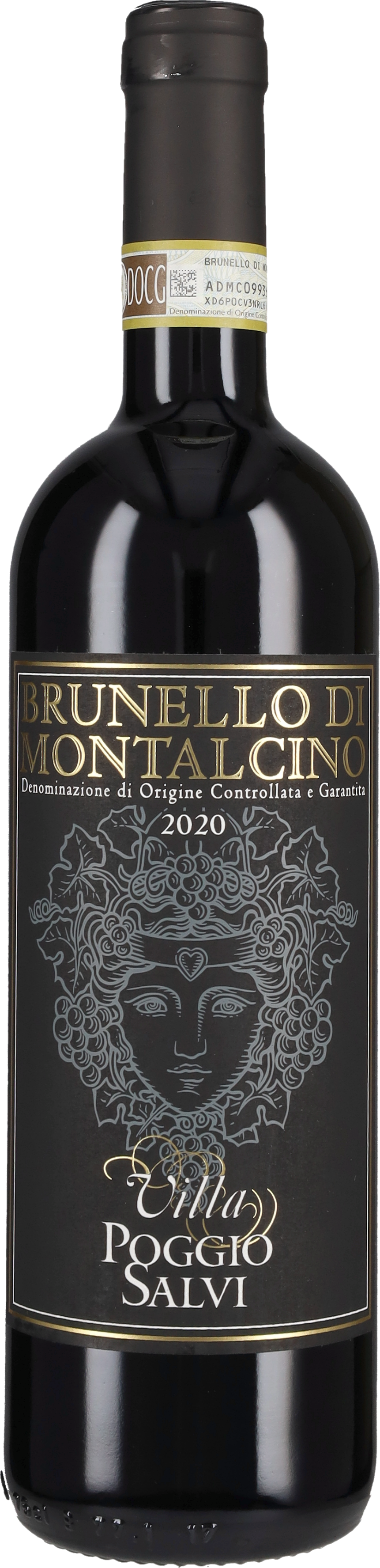
Brunello di Montalcino Villa Poggio Salvi 2021The Brunello di Montalcino from the Villa Poggio Salvi winery is a wine of exceptional quality red made from pure Sangiovese Grosso grapes sourced from vineyards located between 300 and 500 meters above sea level, in a territory, that of the southern part of Montalcino, which benefits from the breeze coming from the Tyrrhenian Sea and the protection of Mount Amiata, creating a particularly favorable climate for viticulture. The vines that produce this Brunello are between 15 and 40 years old and are trained using the spurred cordon method, with a southwest exposure, on soils rich in galestro. The winery, now owner of about 20 hectares of vineyards, is managed by Pierluigi Tagliabue, who was one of the first, in the 1970s, to decide to focus on the Montalcino territory. The Villa Poggio Salvi Brunello di Montalcino is produced with carefully selected and hand-harvested grapes towards the end of September. The bunches are brought to the winery and cold macerated for about 8 days, before being destemmed and crushed to undergo alcoholic fermentation in temperature-controlled stainless steel containers for a few weeks. At the end of alcoholic fermentation, the wine is separated from the skins and remains in aging for at least 30 months in large Slavonian oak barrels, before being bottled and released to the market. The Brunello di Montalcino from Villa Poggio Salvi presents itself with a deep ruby red color. On the nose, intense aromas of overripe red fruit appear, including cherry, sour cherry, and currant, floral notes of violet, and herbaceous and spicy hints of licorice, pepper, and cloves. On the palate, it is concentrated, rich, and structured, with a well-crafted tannic texture accompanied by a pleasant freshness. This Brunello from the Villa Poggio Salvi winery is a pleasant and harmonious expression that tells the story of a unique territory like that of Montalcino.36,00 £*Shipping: 48,00 £Secure redirect to the provider
-
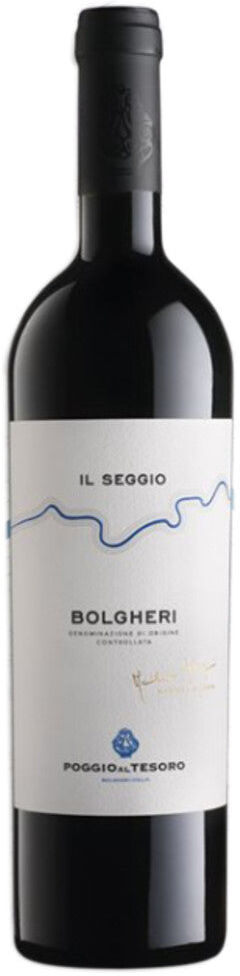
Bolgheri Rosso 'Il Seggio' Poggio al Tesoro 2023Il Bolgheri Rosso “Il Seggio'” di Poggio al Tesoro è un rosso che regala già al primo sorso freschezza e intensità gusto-olfattiva. Questo taglio bordolese dal profilo moderno e mediterraneo deve il suo nome al fiume Seggio, il maggior corso d’acqua del Comune di Castagneto Carducci. La storica casa vinicola Allegrini dal 2003 ha affondato le sue radici in quest’area di eccezionale valore e noto potenziale produttivo con l’idea di dar vita a etichette di forte identità, struttura e lunga evoluzione. Il “Seggio” Bolgheri Rosso è un classico assemblaggio bordolese di varietà internazionali quali Merlot, Cabernet Sauvignon, Cabernet Franc e Petit Verdot che provengono da 2 vigneti principali di proprietà di Poggio al Tesoro: Via Bolgherese e Le Sondraie. I terreni tipici della zona mutano progressivamente dal giallo al marrone, hanno antiche origini marine e sono caratterizzati da sabbie ricche di scheletro che accolgono alla perfezione i Cabernet e da argille miste che regalano eleganza e armonia al Merlot. L’affinamento di 15 mesi in barrique di primo e secondo passaggio, oltre a ridurre la naturale astringenza dovuta ai tannini giovani, permette a questo rosso del Bolgheri di assumere una maggior morbidezza, così da regalare un sorso avvolgente e setoso. Il Bolgheri “Seggio” è un rosso espressivo, pieno e corposo che ben si abbina a primi e secondi piatti a base di carne rossa. Al calice si presenta di un limpido e intenso rosso rubino e al naso dona note inconfondibili di macchia mediterranea, che ci ricordano continuamente la zona di provenienza, frutta rossa matura e erbe balsamiche. Al palato è di buona struttura e consistenza con una trama tannica elegante e avvolgente che lascia in bocca un finale succoso, di media lunghezza e precisione.24,00 £*Shipping: 48,00 £Secure redirect to the provider
-
Why is it souhaite-t-il and not souhaite-s-il?
In French, the pronoun "il" (he) is combined with the verb "souhaiter" (to wish) to form the phrase "souhaite-t-il" because of the rule of verb inversion in interrogative sentences. When forming a question in French, the subject pronoun and the verb are inverted, so "souhaite-t-il" follows this rule. The "t" is added to create a liaison between the verb and the pronoun, making the pronunciation smoother. **
-
What is the difference between il faut que and il faut?
"Il faut" is used to express a general necessity or obligation, while "il faut que" is used to introduce a specific action or event that is necessary or required. For example, "il faut manger" means "it is necessary to eat" in a general sense, while "il faut que tu manges" means "you need to eat" in a specific sense. "Il faut" is used to make a general statement about what is necessary, while "il faut que" is used to specify what needs to be done. **
-
What does 'Rucke di guck, Rucke di guck, Blut ist im Schuh' mean?
"Rucke di guck, Rucke di guck, Blut ist im Schuh" is a German nursery rhyme that translates to "Rock-a-bye baby, blood is in the shoe" in English. The rhyme is a traditional lullaby that tells the story of a baby being rocked to sleep while blood is found in their shoe, which is a metaphor for the baby being cared for and protected. The rhyme is meant to soothe and comfort children as they drift off to sleep. **
-
What comes after il faudrait in French?
In French, "il faudrait" is followed by the infinitive form of a verb. This construction is used to express a suggestion or a polite request. For example, "il faudrait partir tôt" means "it would be necessary to leave early." **
* All prices are inclusive of VAT and, if applicable, plus shipping costs. The offer information is based on the details provided by the respective shop and is updated through automated processes. Real-time updates do not occur, so deviations can occur in individual cases. ** Note: Parts of this content were created by AI.